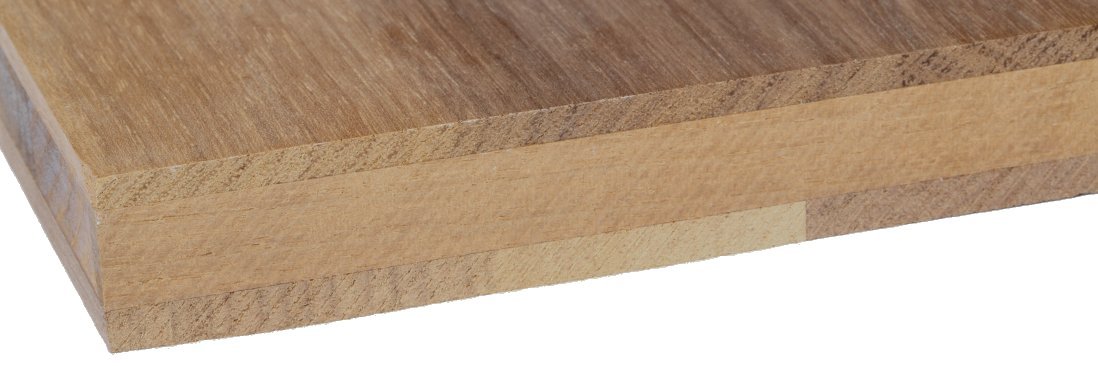

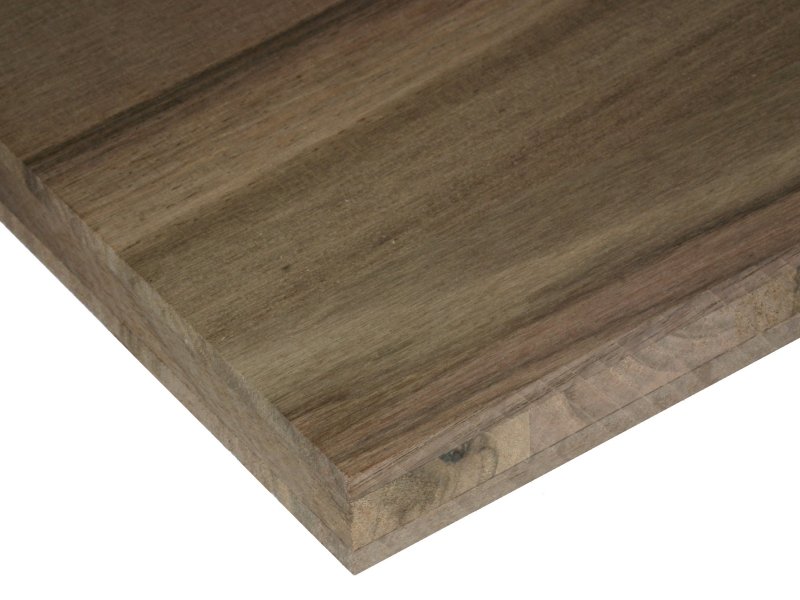
- Special manufacture item
- 20mm, 26mm (others by agreement)
- Maximum size 3000x1250mm
- Typically available within 2-3 weeks in minimum 5 sheets per item
- Bulk packages of mini-bundles (10) and pallets (20)
- Supplied unfinished or with various coatings such as clear lacquer, oils, etc.
- Formaldehyde-free D3 bonded for limited high moisture conditions
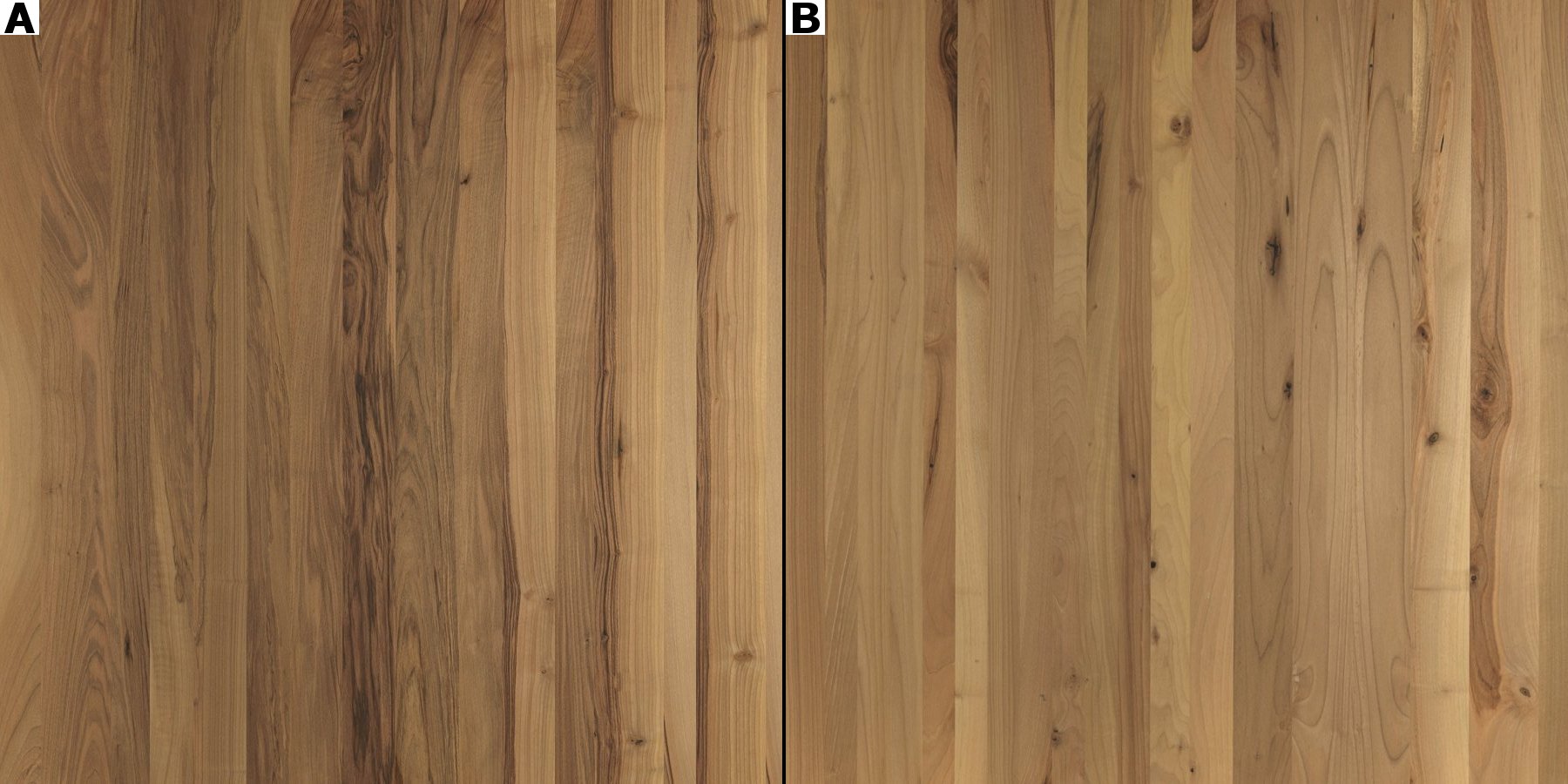
European Walnut A/B
Click to see a typical 1250x1250mm panel face & reverse:
Construction
Specially manufactured in minimum quantity of 5 per item, European Walnut Triply three-layer panels are constructed from 5mm thick, full-length European Walnut faces bonded either side of a cross-banded 10mm or 16mm finger jointed European Walnut core. The faces are made from strips of random width of 50-140mm wide.
The European Walnut strips making up the panel core and faces are bonded together with formaldehyde-free D3 water resistant glue, and the faces calibrated to 80 grit before being protected with shrinkwrapping
The panels can be supplied as produced, or cut or machined to pattern. They can also be supplied prefinished with lacquer, oil, wax or special finishes as required.
Please click on the main European Walnut page for details of the wood
Technical Information
- Construction
- Full length 5mm thick European Walnut staves of random width (50-140mm wide) bonded to a cross-banded finger jointed core of the same species
- Thickness
- 20mm (5mm/10mm/5mm)
- 26mm (5mm/16mm/5mm)
- Others by arrangement
- Standard sizes
- 810x1250mm
- 1000x1250mm
- 1250x1250mm
- 1650x1250mm
- 1900x1250mm
- 2050x1250mm
- 2300x1250mm
- 2500x1250mm
- 2750x1250mm
- 3000x1250mm
- Special sizes
- In principle, any size can be produced up to the maximum stated above
- Calibration
- Final sanding with 80 grit
- Packaging
- Faces individually protected with shrinkwrapping
- Tolerances
- Length/width: +5mm/-3mm
- Thickness: ±0.2mm
- (Others by arrangement)
- Face grades
- A face / B reverse
- Other grading by arrangement
- Bond Quality
- D3 - Limited high moisture applications
- Formaldehyde (CAS # 50-00-0) is not intentionally used in the glue. However, trace levels (< 0.02%) may be present as a result of the specific characteristics of the raw materials and/or of the manufacturing process
- Other features
- Other woods can be incorporated into the construction of the panel to achieve a decorative or contrasting effect
Design, storage & processing
- Design & storage
- Although these panels are more stable than solid lumber, it is vital that design of any installation allows for the risk of movement due to changes in ambient moisture or long-term forces acting upon the panel
- The panels should remain within their protective film until ready for conversion into their finished sizes
- Immediately upon receipt, the panels must be stacked directly on top of each other and fully supported on perfectly flat, uniform supports - the top panel should be fully covered with chipboard or MDF, and all edges left allowed to receive good air circulation. This can be done with the help of lining strips/slats
- The panels must then be covered carefully to ensure temperatures and air humidity are maintained from receipt of the panels right up until further processing
- Air humidity should remain between 28%-58% and a temperature range of 17-24°C in order to maintain flatness. (Higher air humidity will lead the panels to take up moisture and swell, while lower air humidity will cause them to give up their inner cell moisture and shrink)
- NB: Extremes outside the above ranges risk damage to the panels, so it is vital to ventilate the storage to ensure the conditions needed.
- Processing
- After cutting the panels to their final dimension and before final processing, it is strongly recommended that the panels are left to acclimatise for a few days with the panels stacked directly one on another (still in their clear film if possible) and the top panel of the stack be covered with chipboard, MDF or similar lower humidity product.
- If one or more of the above cannot be followed it is safest to keep the panels as supplied, with the film intact, and stored carefully on a horizontal surface covered in full length and stacked one panel directly on another and a sheet of chipboard or similar panel with lower humidity used as a cover sheet.
- You should keep them stored this way until actually processing them further.
- Important: To minimize the chance of deflection, panels should always be processed simultaneously on both sides (sanding, brushing, profiling, lacquering / oiling) and the thickness of the outer layers remain balanced on both sides of the core after processing
